Beyond Distribution Matching:
Selective Margin Preservation for Supervised Fine-Tuning
1Peking University 2Qiyuan Tech 3Xidian University 4The University of Hong Kong
* Equal contribution † Corresponding author
ACL submission · arXiv:2610.19685v1
Abstract
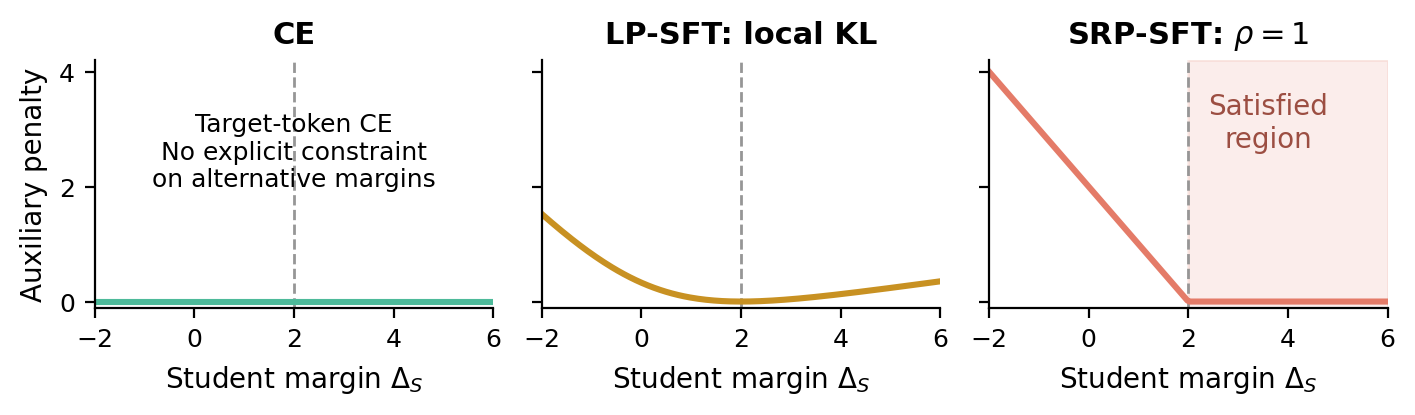
Supervised fine-tuning changes logit margins among non-target tokens at teacher-forced prefixes. Matching a local reference distribution keeps those probabilities and also penalizes margin expansions. SRP-SFT asks whether a soft auxiliary can preserve selected local non-target margin relations without freezing that distribution. A frozen reference selects top-K non-target pairs; a hinge penalty activates only when the student falls below a reference-scaled lower bound. Once the bound is met, the auxiliary stops acting.
Method
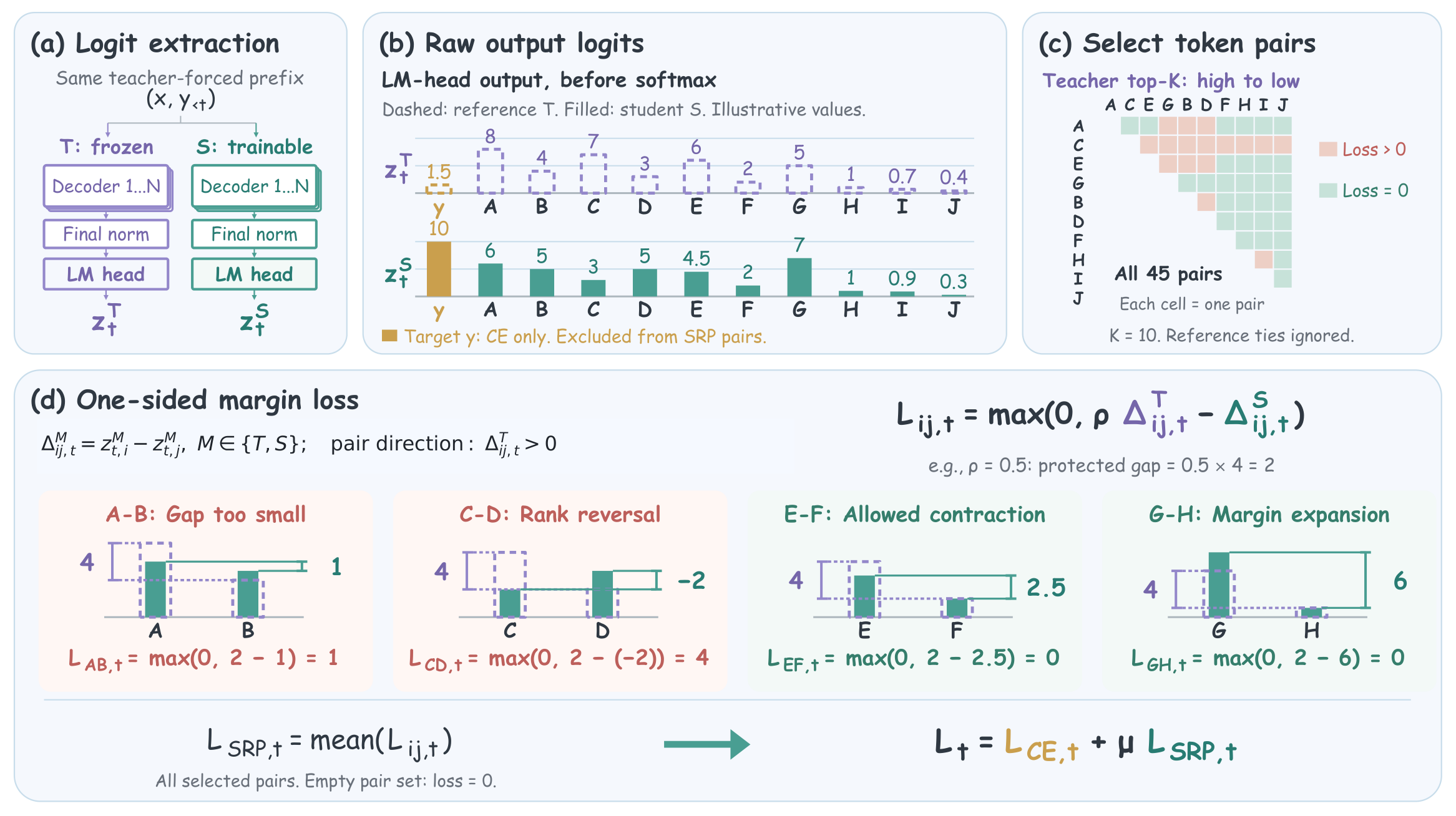
The target token remains the job of cross-entropy. SRP-SFT only repairs selected teacher-preferred alternative pairs when their margin becomes too small. CE supervises the observed target, while distribution matching can over-constrain useful adaptation.
Reference-guided set
Select the frozen model's top-K non-target alternatives at the same teacher-forced prefix.
Teacher-preferred pairs
Keep one orientation for every strictly ordered pair, up to K(K−1)/2 constraints.
One-sided hinge
Penalize only violations of the scaled lower bound; expansion beyond the bound is free.
Results
Qwen3-4B-Base on UltraFeedback, seed 1234. Reasoning and code are reported under the paper's common one-epoch screen.
| Method | MATH p@1 | MATH p@4 | AIME p@1 | HE+ p@1 | MBPP+ p@1 | Mean |
|---|---|---|---|---|---|---|
| CE | 34.08 | 59.96 | 0.82 | 43.38 | 43.36 | 36.20 |
| LP-SFT | 49.78 | 77.06 | 2.86 | 57.53 | 50.29 | 42.52 |
| SRP-SFT | 54.56 | 80.50 | 4.76 | 62.84 | 56.24 | 45.11 |
Independent seed checks keep the same ordering on reasoning: SRP-SFT reaches 44.05 / 44.35 across seeds 42 / 3407, while its code mean is 65.78 / 69.48.
Mechanism
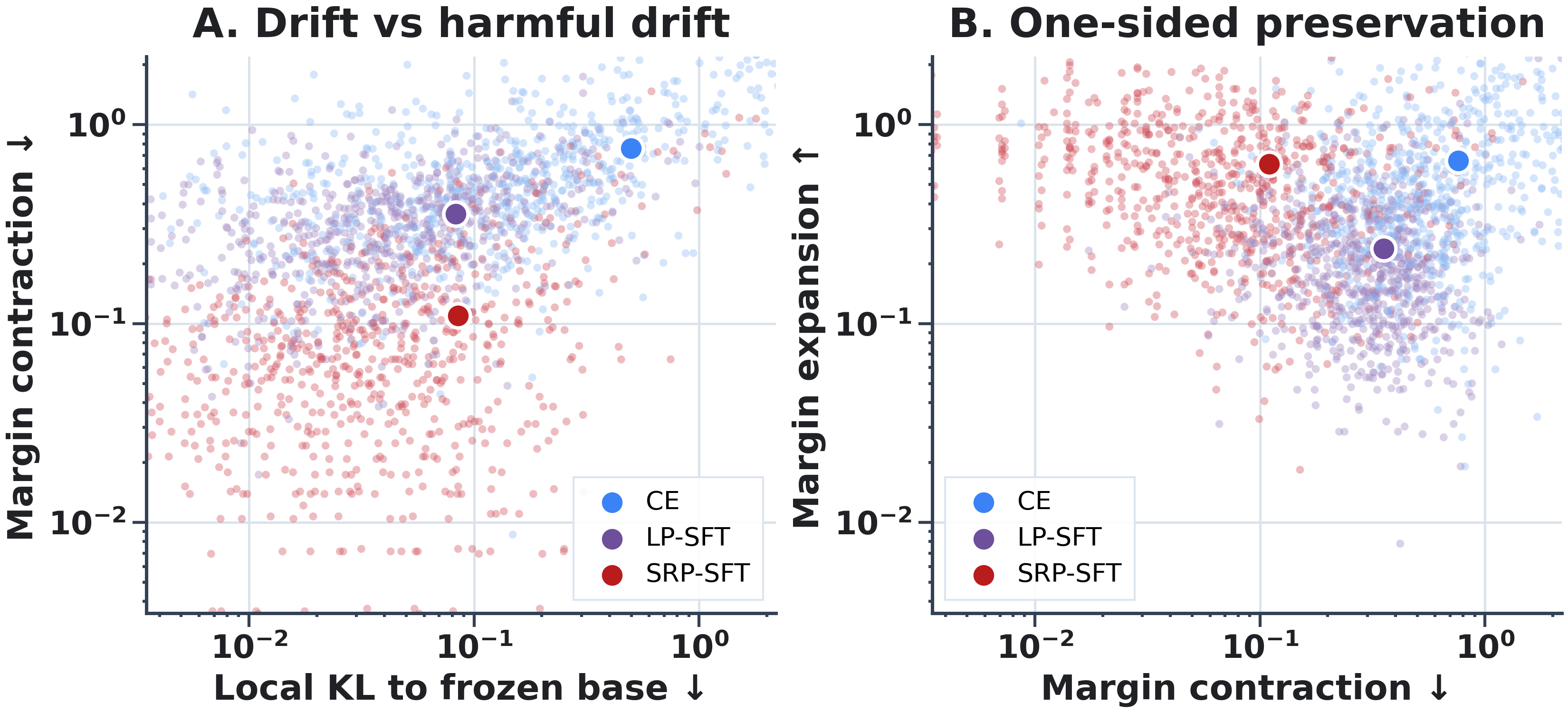
On 998 held-out examples, SRP-SFT reduces contraction and rank inversions while allowing more margin expansion. Preservation is about geometry, not only KL.
Local KL
Lower stays closer to the reference
Flip rate
Inverted teacher-preferred pairs
Contraction
Lower means less margin collapse
Expansion
Room left once the bound is met
Design choices
Exclude the target
Cross-entropy learns the observed response token; the auxiliary only acts on non-target alternatives.
Keep the direction
The frozen reference orients each pair, so the student is asked to avoid losing a preferred relation.
Stop at the bound
Once the scaled margin is met, expansion is allowed. The auxiliary does not force exact distribution matching.
BibTeX
@article{wang2026srpsft,
  title={Beyond Distribution Matching: Selective Margin Preservation for Supervised Fine-Tuning},
  author={Wang, Yuxuan and Zhao, Guangxiang and Tan, Xinyu and Han, Yahui and Yin, Xinxiang and Wu, Zhonghai and Zhang, Xiangzheng and Sun, Lin and Yang, Tong},
  journal={arXiv preprint arXiv:2610.19685},
  year={2026}
}